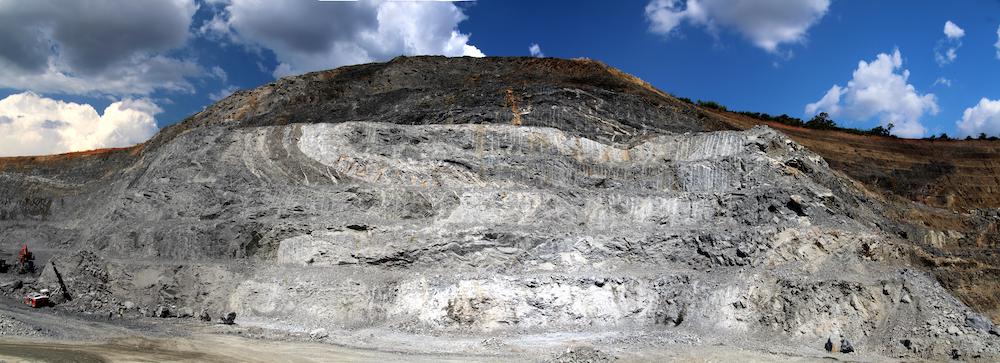
Evolution of Orogenic Copper Mineralization at the Structurally-complex Frontier Mine, Zambian Copperbelt, Democratic Republic of the Congo
Tect was approached by ERG Africa in 2020 to conduct detailed mapping and a structural interpretation of Frontier Mine with the aim of constructing an implicit 3D geological, structural and grade shell model in LeapfrogGeo. The study enhanced the understanding of the deposit’s host stratigraphy, structural evolution and ore controls, providing a robust, working baseline model for Geotechnical Engineers, Geologists and Hydrogeologists. Tect’s structural analysis integrated surface mapping with downhole geotechnical, macrostructural, lithological and grade data to construct a fully-constrained 3D implicit model. An Apparent Dip Analysis on the pit design and proposed cut-back was conducted to identify areas for geotechnical monitoring and slope optimization.
The Zambian and Congolese Copperbelts, part of the Lufilian Fold-and-Thrust Belt, represent the world’s largest repository of sediment-hosted Cu-Co mineralisation. The Neoproterozoic Katangan Supergroup was deposited within a series of linked intra-cratonic rift basins that closed during convergence of the Kalahari and Congo Cratons during the Pan-African Orogeny (590–500 Ma). Frontier Mine, on the northeastern flank of the Kafue Anticline/Dome, is a unique deposit: Cu mineralisation is hosted in sets of quartz-carbonate veins within the Mwashya Subgroup, and shows a spatial association with sodic (albite) alteration and enhanced, localised strain at the Mwyashya-Grand Conglomerate contact. The more commonly mineralized Lower Roan Subgroup is notably absent at Frontier Mine.
The deposit occurs within a first-order, recumbent fold (F1) trending NW-SE and plunging shallowly to the SE, which was co-axially refolded by a second generation of upright folds (F2). Syn-orogenic, Cu-bearing quartz-carbonate veins occur as distinct sets related to progressive deformation during the Lufilian Orogeny. High-grade ore shoots are developed in F2 fold hinges and show a prominent shallow plunge to the SE, consistent with measurements of fold axes and lineations. Mineral assemblages indicate middle to upper greenschist facies metamorphism. This study was published in a peer-reviewed paper entitled: Deformation, alteration and implicit 3D geomodelling of deposit-scale controls of vein-hosted copper mineralization of the Frontier Mine, Democratic Republic of Congo by Heike Fourie, Alex Kisters and Ian Basson (2025). Mineralium Deposita, https://doi.org/10.1007/s00126-025-01351-1