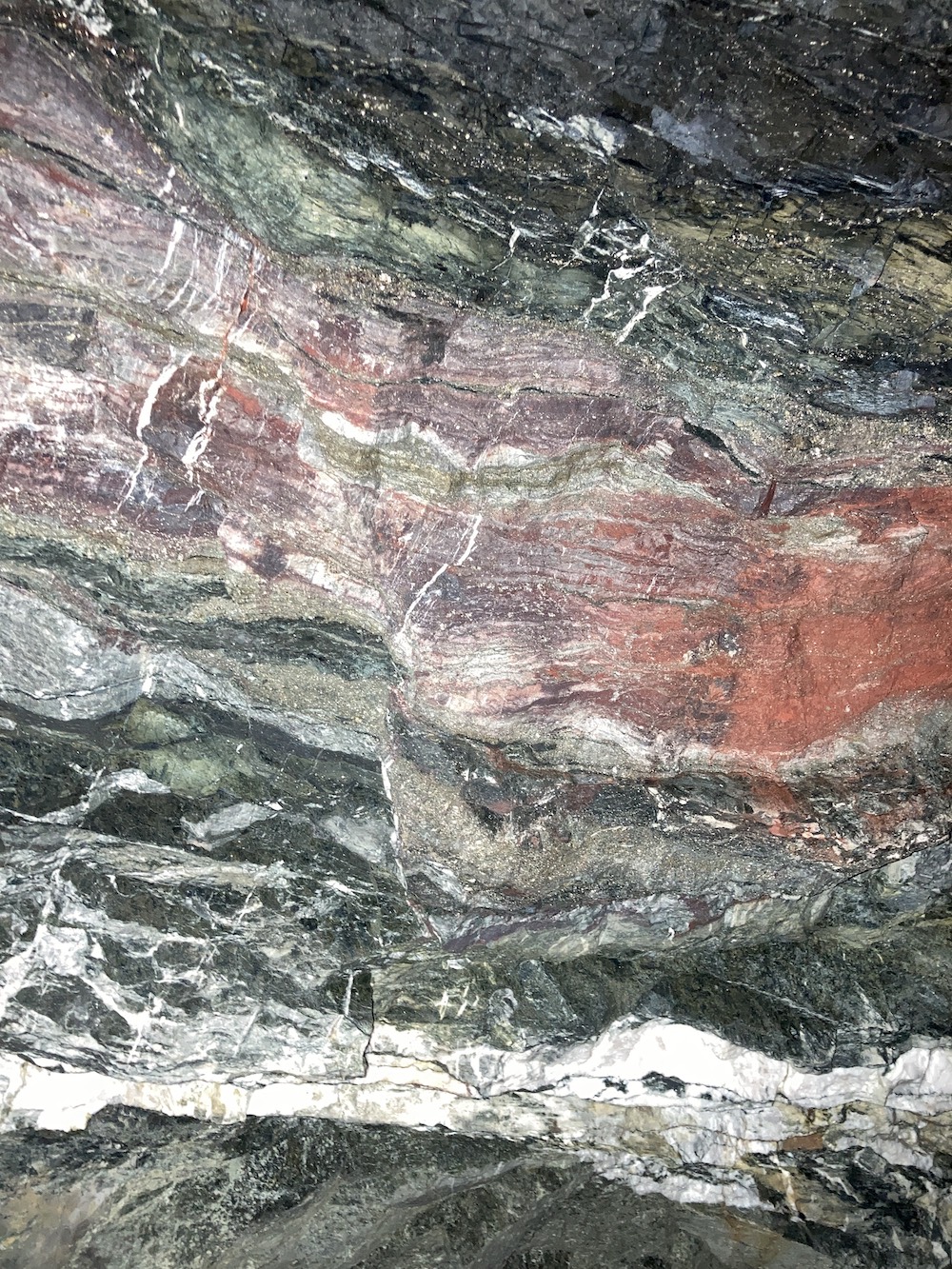
Orogenic gold mineralization within steeply-dipping Banded Iron Formation and Jaspilite, Pickstone-Peerless Mine, Chegutu Greenstone Belt, Zimbabwe
Dallagio Investments’ Pickstone-Peerless Mine, located 10 km west of the Great Dyke within the Chegutu Greenstone Belt in the Mashonaland West Province, approached Tect to establish the structural controls on auriferous mineralization. These findings were to be integrated, along with underground and open pit drilling, mapping and other historical data, into a fully-constrained 3D implicit grade shell model for resource estimation update, mine design and exploration drillhole planning.
The encompassing greenstone belt consists of Western Succession Greenstones of the Bulawayan Supergroup (2715-2683 Ma), comprising interlayered, calc-alkaline, intermediate and felsic volcanic, volcanoclastic units and lesser komatiitic and tholeiitic basalts, minor banded iron formation, shale, quartzite and carbonate. The local tectonostratigraphy consists of a variety of altered schistose lavas, shale and intrusive units. Mineralization is associated with east-west trending, steeply-dipping BIF, jaspilite and dolomite units that have locally undergone brecciation and stockworking due to their relatively higher competency.
Mineralization consists of auriferous sulphides (pyrite – chalcopyrite ± arsenopyrite), as massive veinlets or lodes parallel to the overall foliation and, locally, as highly sheared and sheeted stringers. Hydrothermal quartz-carbonate and carbonate veining within the orebody package includes foliation-parallel, fault-fill veins and sub-horizontal (brittle) extension veins. The central orebody package displays an overall pinch-and-swell geometry. Swells contain chaotic stockwork and boxwork breccias, representing relatively higher fluid throughput, alteration and mineralization.
The relatively competent central orebody package (compared to hangingwall and footwall schists) comprises a rheologically-/lithologically-controlled shear corridor, which shows brittle-ductile, sinistral, top-to-the-north kinematics. Narrowing and pinch-outs of the central orebody taper off into sheared and isolated sulphide stringers, associated with an increase in strain and deformation within the surrounding schists, accompanied by a noticeable increase in talc content.